Switchable glass
SWITCHABLE GLASS — PDLC SMART GLASS TECHNOLOGY BY CITYSTAR FILMSwitchable glass built on Filmbase’s premium Polymer Dispersed Liquid Crystal technology gives architects, designers and building owners a level of control over glass that was impossible a generation ago. The glass can be turned on, tu
Product Details
SWITCHABLE GLASS — PDLC SMART GLASS TECHNOLOGY BY CITYSTAR FILM
Switchable glass built on Citystar premium Polymer Dispersed Liquid Crystal technology gives architects, designers and building owners a level of control over glass that was impossible a generation ago. The glass can be turned on, turned off, or set to any intermediate level of diffusion in a matter of milliseconds, which makes it suitable for an extraordinarily wide range of light control, privacy and display applications. This article explains what switchable glass is, how the PDLC effect works, what the real performance figures are, how the two delivery formats differ, where the product is used, how it is controlled and installed, and what a buyer should insist on before placing an order.
WHAT SWITCHABLE GLASS IS
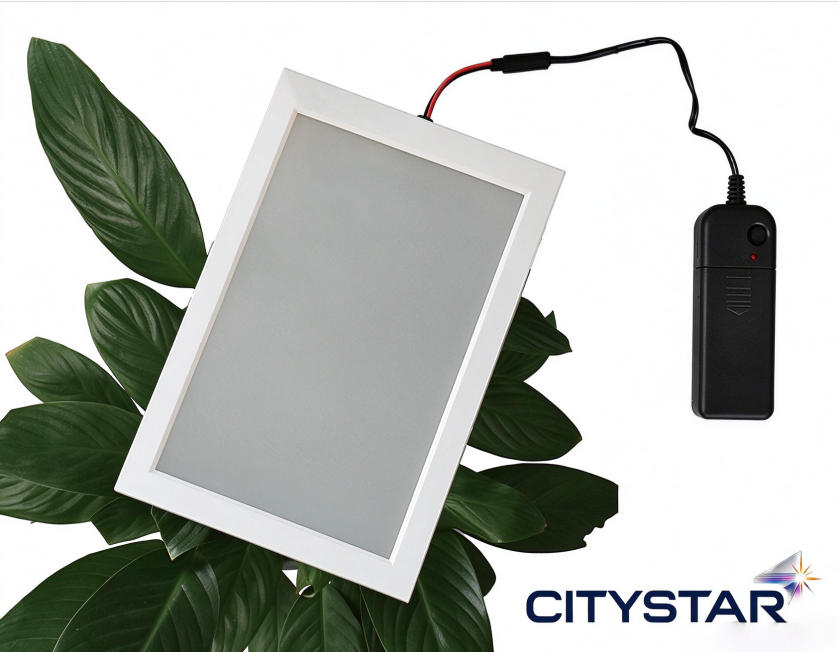
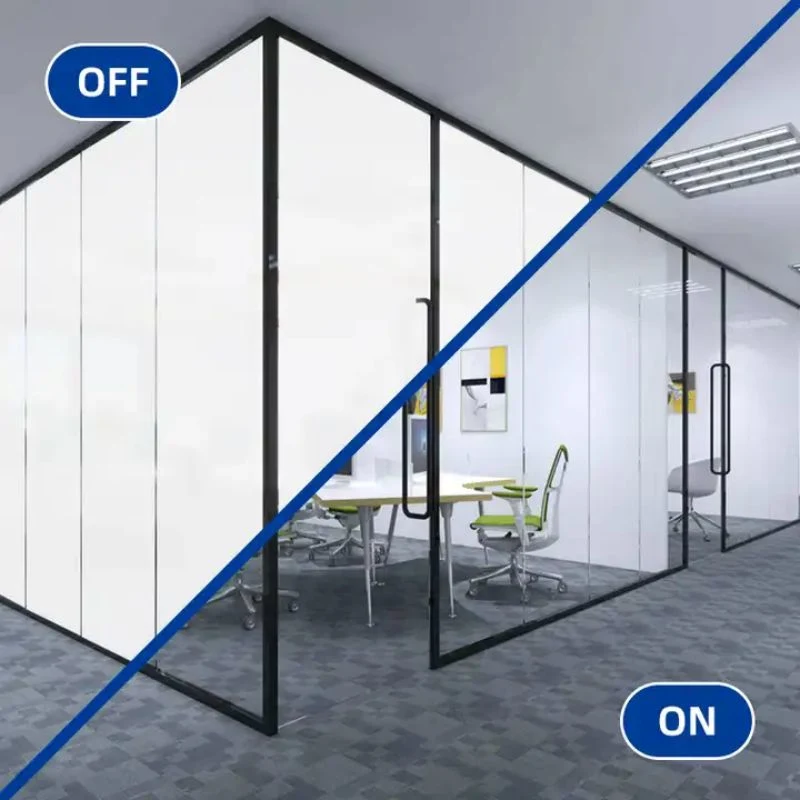
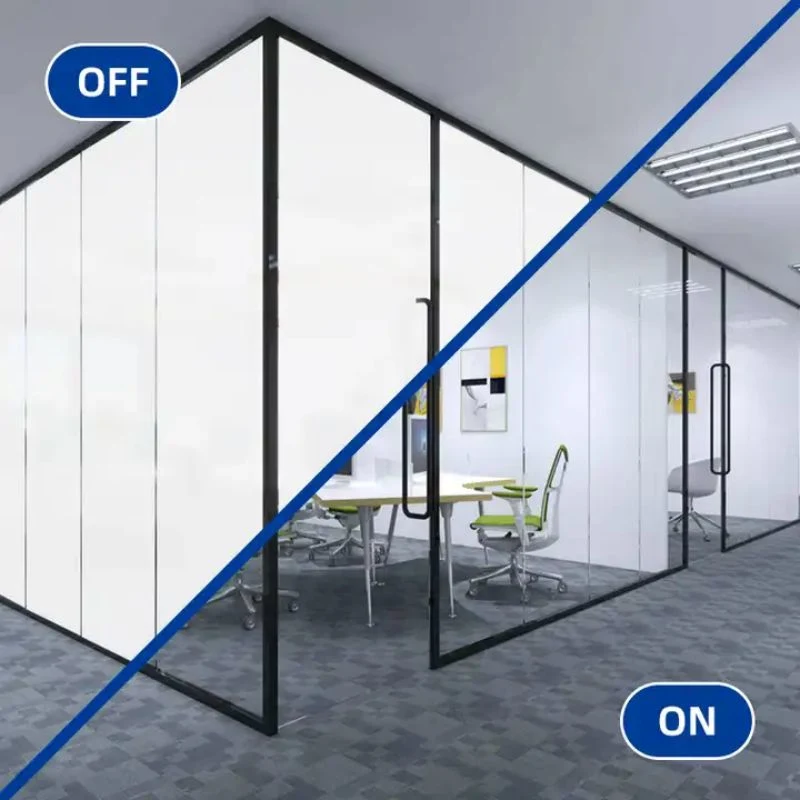
Switchable glass, also sold as smart glass, privacy glass, electric glass, dimmable glass or electronically controlled glass, is a laminated glass product that contains a liquid crystal and polymer film as one of its interlayers. In the absence of an electric field, the electronically controlled PDLC layer sits in its natural, unpowered condition, and the glass appears translucent, milky or frosted. It still transmits a large share of daylight, so the room behind stays bright, but the image behind the panel is diffused until it becomes unrecognisable. That diffusion is what the market calls privacy. When an alternating current is applied across the transparent conductive layers that sandwich the liquid crystal layer, the liquid crystals align and the glass changes from the opaque state (OFF) to the transparent state (ON). The change is fast, smooth and repeatable, and it can be performed thousands of times a day for many years without visible degradation.
THE PHYSICS, IN PLAIN LANGUAGE
PDLC stands for polymer dispersed liquid crystal. Inside the active layer, microscopic droplets of liquid crystal are dispersed throughout a cured polymer matrix. In the unpowered state the liquid crystal molecules inside each droplet point in random directions. Light entering the glass meets a series of boundaries between polymer and liquid crystal with mismatched refractive indices, and it scatters in every direction. That scattering is the frosted appearance. When an electric field is applied, the molecules align with the field, the refractive indices match, and light passes through without scattering. The glass becomes clear.
Three practical points follow from this physics, and every buyer should understand them. First, the film must be driven by alternating current, not direct current. A sustained DC field causes ionic migration inside the liquid crystal layer and will damage the product over time. Switchable glass is therefore always supplied with a dedicated driver that converts mains power to a low AC output, commonly in the 36 to 60 volt range. Second, the switching speed is measured in milliseconds, typically single digits to a few tens of milliseconds depending on the film grade, the panel size, the driving voltage and the ambient temperature. To the human eye the transition reads as instantaneous. Third, the unpowered state is the private state in standard PDLC. That is a deliberate safety and security characteristic: if power is lost, the glass fails to privacy rather than to transparency. A reverse mode variant exists, clear when unpowered and frosted when powered, and it is used where a clear default is required for daylight, safety or visual openness. The mode must be fixed in writing before production.
TWO WAYS TO BUY THE SAME FUNCTION
Switchable glass is delivered in two commercial forms, and choosing between them is the first real decision in any project.
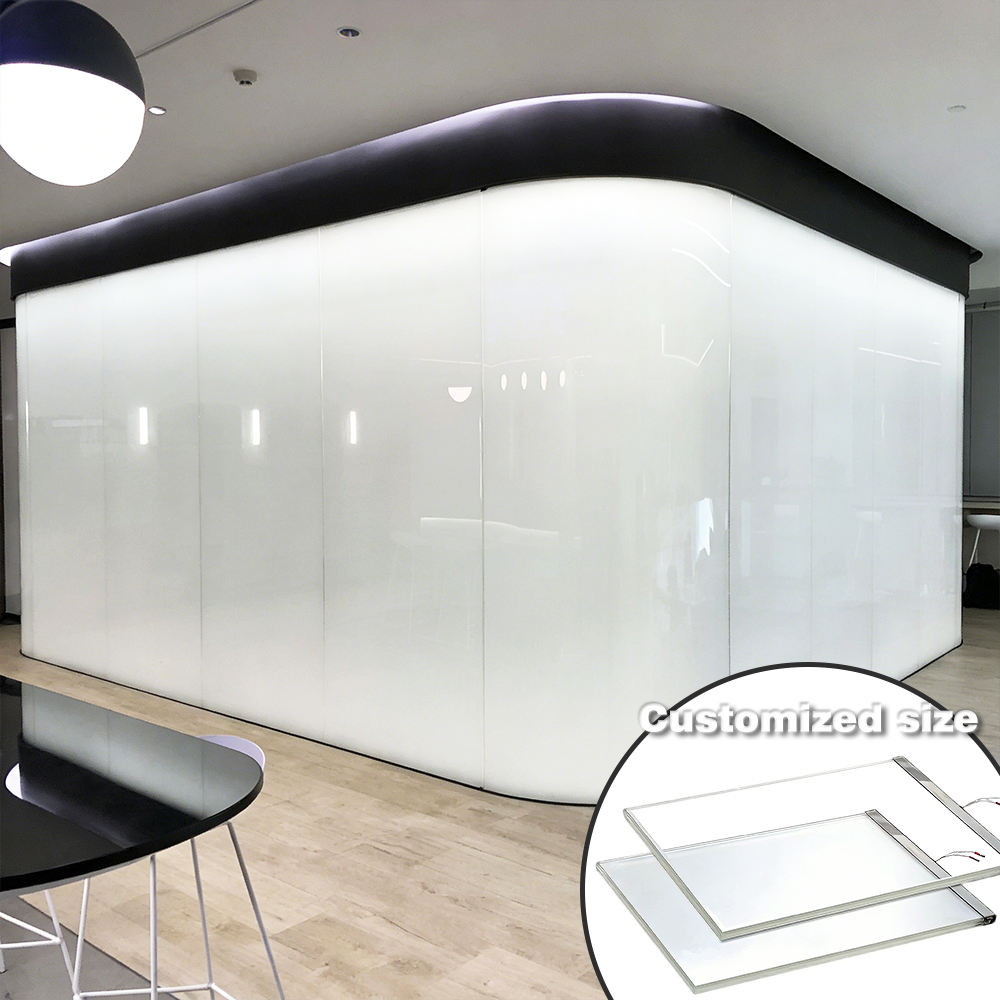
The first is laminated switchable glass, where the PDLC film is sealed inside the glass sandwich during lamination, usually between two panes with PVB or EVA interlayers. This is a finished factory product. It has no field installation of film, no visible film edges, no risk of bubbles or contamination, and it can be combined with tempered glass for safety, with Low-E coatings for thermal performance, with tinted or reflective glass for solar control, and with insulating glass units for facade work. It is the correct specification for curtain walls, external windows, high-end interiors, marine and transport applications, and any project where the client expects a glass product rather than a film installation. The trade-offs are cost, weight, lead time and the need for qualified glass processing.
The second is self-adhesive switchable film, applied directly to existing glass on site. It is supplied with a protective front layer and a release liner over the adhesive face. The installer cleans the glass, positions the sheet, removes the liner progressively, squeezes out air and trims the edges. This route is ideal for retrofit, for rented or temporary spaces, for glass that cannot be removed, and for small quantities where lamination is uneconomic. It demands cleanliness and skill: dust, finger marks and trapped air are permanent and highly visible. The film is also more exposed, so the front protection and the edge sealing matter more than in the laminated route.
WHAT THE NUMBERS ACTUALLY MEAN
Visible light transmittance in the clear state ranges across the product family from roughly 75 percent on economy grades up to 90 to 92 percent on our flagship Citystar 091 specification. Haze in the clear state is the figure that separates a premium product from a mediocre one: the lower the haze, the more the glass resembles ordinary clear glass when switched on, and the less the designer’s original vision is disturbed. Haze in the opaque state, by contrast, should be high, because that is privacy. Ultraviolet rejection is a genuine strength of the product, typically in the region of 98 to 99 percent, protecting interior finishes, fabrics, artwork and skin. Infrared performance is more modest than a true Low-E coating, so where thermal performance matters, combine the switchable interlayer with a Low-E pane inside an insulated unit rather than expecting the film alone to deliver a U value. Power consumption in steady state is low, typically a few watts per square metre with a brief inrush at switch-on. Acoustic improvement is real but modest, coming from the mass and damping of the interlayer, and switchable glass should not be sold as an acoustic product. Buyers should also obtain, in writing, the operating temperature range, the switching cycle rating, the expected service life and the warranty terms covering delamination, busbar failure and loss of switching uniformity.
WHERE SWITCHABLE GLASS EARNS ITS PLACE
Privacy on demand is the first and largest application. Conference rooms, executive offices, consulting and interview rooms, bank counters, clinic and hospital partitions, hotel bathrooms, shower enclosures, dressing areas and residential bedrooms all benefit from a surface that is clear in normal use and private instantly when required. The commercial argument is simple: instant privacy without blinds, curtains or roller shutters, and without the visual clutter they bring to a clean architectural interior.
Design and aesthetics is the second. Switchable glass allows a wall of glass to read as a solid luminous panel, a signage surface or a projection screen, and then open up to transparency when the space needs to feel larger. Retail storefronts close at night and reveal their merchandising by day. Showrooms, museums, galleries and exhibition booths use it for reveal effects and for zoning. Hospitals use it to protect patient dignity while keeping wards observable by staff.
Control and automation is the third. Because the product is an electrical device, it integrates with wall switches, remote controls, multi-zone controllers, timers, daylight and occupancy sensors, access control and card readers, building management systems, and smartphone or voice platforms. A glass door can be programmed to frost automatically when locked. A bathroom panel can be tied to the light switch. A meeting room can be linked to its booking calendar so the glass is private during meetings and clear when the room is free.
Transport, marine and specialty uses form the fourth. Yachts, cruise ships, trains, buses, automotive sunroofs and privacy screens all rely on the same physics, specified differently for vibration, safety glazing compliance, temperature extremes and power supply stability.
SPECIFYING CORRECTLY, AND AVOIDING THE USUAL FAILURES
Start with the mode, normally opaque or reverse. Then choose the delivery route, retrofit film or laminated glass. Then fix the panel sizes and the zone layout, because there are practical limits on film width and length, on how many panels one driver can supply, and on the maximum current per circuit. Then define the electrical package in full: driver rating, wiring diagram, cable runs, control method and any integration requirement. Then define the glass build-up if laminated: glass types, thickness, tempering, coating, tint, interlayer and whether the unit is single or double glazed. Then define the environment: indoor or outdoor, humidity, direct sun, cleaning regime and expected cycling. Finally, define the commercial terms and the warranty scope.
Most failures in this category are not film failures. They are specification failures: the wrong mode, an undersized driver, a wiring run so long that voltage drop causes patchy switching, film installed over a contaminated surface, an edge left unsealed in a wet room, or a client expectation that was never written down. A supplier who asks these questions before quoting is worth far more than a supplier who quotes the lowest price per square metre.
ABOUT CITYSTAR FILM
Citystar Film, based in Wuhu, Anhui Province, China, supplies switchable glass, PDLC and PNLC dimming film, interlayer material for laminators and finished laminated smart glass to customers worldwide. Our range covers the cost-effective 85 percent transmittance grade, the popular 87 percent grade, and the flagship Citystar 091 at 90 to 92 percent transmittance with haze below 3 percent. Every quotation states the mode, the optical figures, the electrical package and the warranty scope. We ship with installation guidance and English-language technical support.